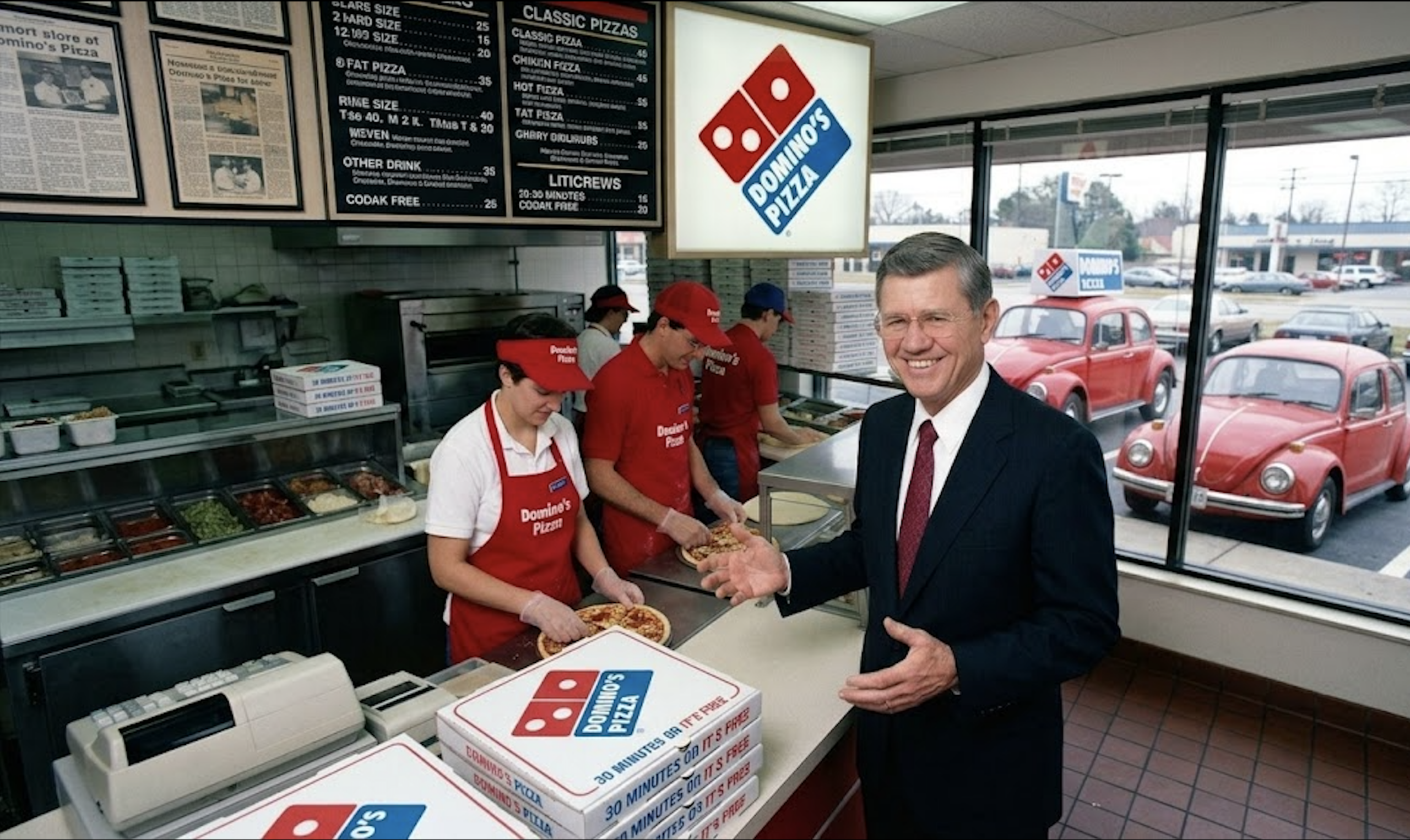
The history of entrepreneurship is littered with stories of “accidental” success, but few are as methodically disruptive as the rise of Domino’s Pizza. What began as a desperate attempt by a Michigan student to fund his architecture degree transformed into a masterclass in business model innovation, logistical engineering, and radical marketing.
This is not just the story of a pizzeria; it is a blueprint for how a brand can dominate a saturated market by identifying a single point of friction and solving it better than anyone else. In 1960, Tom Monaghan was a man driven by necessity. Alongside his brother, James, he acquired a small, struggling pizzeria named “DomiNick’s” for a mere $900—most of which was borrowed. At the time, Monaghan lacked a formal business education, but he possessed a trait often missing in corporate boardrooms: the willingness to listen. The original DomiNick’s was located near a student dormitory in Michigan. Recognizing that his primary demographic was students, Monaghan did something revolutionary in its simplicity: he asked them what they wanted. While Monaghan initially experimented with traditional variables like toppings and service styles, a single piece of feedback from a student changed the trajectory of the food industry:
“Everything satisfies us… but in reality, we are already tired of coming all the way here every time for a pizza. We waste pointless time… if you brought it to us at the dormitory, that would definitely be very good.”
This was the birth of the “Value of Convenience.” Monaghan realized he wasn’t just selling dough and cheese; he was selling time.
The 30-Minute Guarantee: Disrupting the Market with Radical Constraints
Before Domino’s, delivery existed, but it was an afterthought—a secondary service characterized by lukewarm food and unpredictable wait times. Monaghan decided to make delivery the core product.
The “Assembly Line” Menu Radicalism
To promise a 30-minute delivery timeframe, Monaghan had to re-engineer the kitchen. He observed that a diverse menu—including sandwiches and pies—created “choice paralysis” for the customer and “operational drag” for the cooks. In a move that many viewed as business suicide, Monaghan purged the menu. He removed everything except pizza, and initially, he limited that pizza to a single size.
-
Result: The kitchen became an assembly line.
-
Speed: Pizzas were prepared in seconds, not minutes.
-
The Moat: This operational efficiency allowed for the legendary “30 minutes or it’s free” promise.
Although the guarantee was eventually retired due to safety concerns regarding delivery drivers, the psychological impact was permanent. In the mind of the consumer, Domino’s became synonymous with guaranteed speed.
The “No Tables” Business Model: Engineering High Margins
While competitors like Pizza Hut were investing in large, high-rent real estate with waiters, dishwashers, and extensive furniture, Monaghan pivoted to a “dark kitchen” philosophy decades before the term became trendy. Monaghan’s “No Tables” strategy was a masterstroke in overhead reduction. By stripping away the “restaurant” experience, he achieved:
-
Low Rent: Pizzerias could be located in side streets or small storefronts because they didn’t need “foot traffic” visibility.
-
Labor Efficiency: No waiters meant savings on wages and the complexities of front-of-house management.
-
Utility Savings: No dishwashing meant lower water bills and less equipment maintenance.
-
Scalability: The low-cost entry point allowed Domino’s to replicate the model across the country at a fraction of the cost of a traditional sit-down restaurant.
The path to billions was not linear. In a moment that has since become a legend in business history, Tom’s brother, James Monaghan, grew weary of the grueling hours. Seeking the “stability” of his job at the post office, James traded his half of the business for the company’s delivery vehicle—a Volkswagen Beetle. Tom Monaghan, now the sole owner, began a decade-long marathon. He reportedly worked 100 hours a week, often sleeping on bags of flour in the store. This level of “founder grit” was tested further when:
-
The Jim Gilmore Crisis: A bad management partnership left the company in massive debt.
-
The Great Fire: A fire leveled the company’s headquarters, destroying all accounting records and stock.
-
The Banker Takeover: In the early 70s, banks ousted Monaghan, claiming he was a poor manager.
However, the “professional managers” failed because they didn’t understand the nuances of the pizza business. Quality plummeted, and sales cratered. When Monaghan was eventually invited back, he spent 9 years meticulously paying off every cent of the company’s debt, proving that character and domain expertise are the ultimate assets in a crisis.
Logistical Revolutions: The Corrugated Box
One of Monaghan’s most underrated contributions to the industry was the corrugated cardboard box. Prior to Domino’s, pizzas were delivered in thin, flexible paperboard. This caused two problems:
-
The steam would soften the box, causing the lid to sag and stick to the cheese.
-
The pizza would lose heat rapidly.
Monaghan’s introduction of the rigid, corrugated box allowed for heat retention and “stackability,” enabling drivers to carry multiple orders at once without ruining the product. This was the technological foundation that made large-scale delivery possible.
The “Driver-to-Owner” Pipeline: A Masterclass in Loyalty
Domino’s has one of the most unique franchising models in the world. Over 90% of franchise owners started as delivery drivers or dough makers. Monaghan’s rule was strict: To own a Domino’s, you had to have worked there for at least a year. This created:
-
Operational Excellence: Owners knew the business from the “oven up.”
-
Unrivaled Loyalty: Employees didn’t see their jobs as dead-ends but as “millionaire apprenticeships.”
-
Cultural Consistency: The brand’s DNA was preserved even as it scaled to thousands of locations.
Monaghan’s marketing tactics were often as radical as his operations. To destroy local competition, he used a “Business Card Exchange” strategy: Employees would visit homes and offer a free Domino’s pizza in exchange for the business cards of two competitors. This effectively wiped out the competition’s physical presence in the customer’s home, ensuring that the only number on the fridge was Domino’s. Furthermore, Monaghan pioneered “Sales Cannibalization.” He would intentionally open stores within the same neighborhood. While this seemed to “steal” sales from his own existing stores, it reduced delivery times from 15 minutes to 8 minutes. The result? Hotter pizza and higher customer retention, which ultimately increased the total market share and blocked competitors from entering the area.
Even after Monaghan’s era, the company stayed true to his spirit of radical decisions. In 2009, under CEO Patrick Doyle, Domino’s faced a crisis: consumers hated the taste of their pizza.
Instead of hiding, they launched the “Pizza Turnaround” campaign. They aired commercials showing focus groups calling their crust “cardboard” and their sauce “ketchup.” They publicly admitted, “Our pizza is bad,” and then they changed everything.
-
The Result: This transparency built immense trust. When the new recipe launched, sales skyrocketed, and Domino’s stock became one of the best-performing assets of the decade, even outperforming tech giants like Apple and Google in certain windows.
Tom Monaghan’s story is a testament to the power of focus, resilience, and listening to the customer. He took a commodity product and turned it into a logistical marvel. As Steve Jobs once remarked:
“If there were 50 leaders like him, they would occupy the first fifty places in Fortune magazine one after another.”
For today’s marketers and entrepreneurs, the lesson is clear: Identify the friction, simplify the solution, and never, ever give up on the quality of your execution.