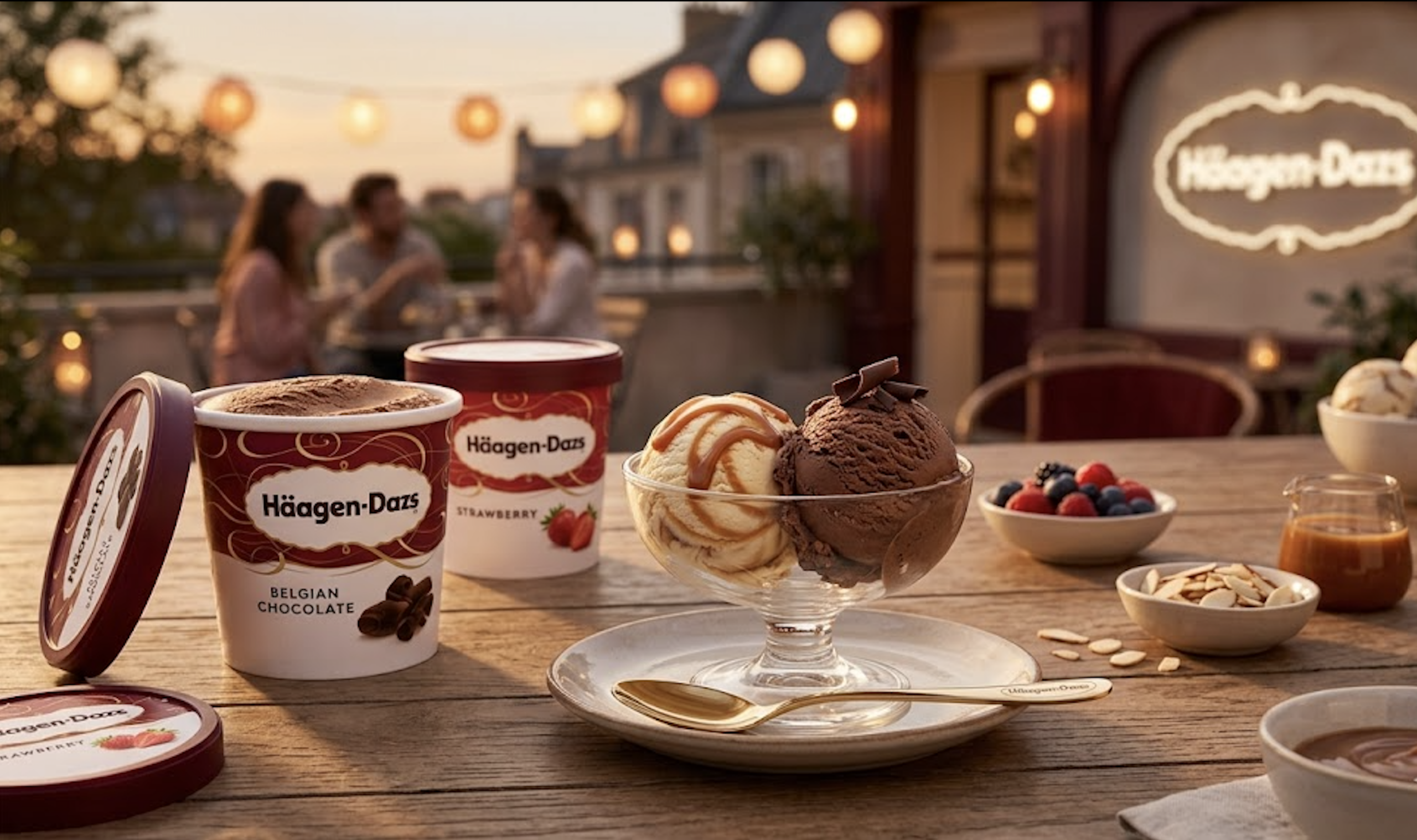
In the mid-20th century, specifically during the post-war industrial boom, the American market was flooded with cheap, mass-produced ice creams. These commodity products were primarily aimed at children and were almost exclusively associated with summer fun and casual consumption. However, Reuben Mattus—a visionary Polish-Jewish immigrant who had spent decades selling ice cream from his family cart on the busy streets of the Bronx—realized something vital and transformative for the industry: people are willing to pay more not just for a product, but for “status” and a “story” that elevates their social standing.
The Masterclass in Foreign Branding and Linguistic Psychology
Thus, Häagen-Dazs was born—a brand that has gone down in marketing history as the most brilliant and enduring example of creating real wealth through a carefully crafted “fake identity.” In the realm of strategic marketing, there exists a sophisticated concept called Foreign Branding. This is a deliberate strategy where a company invents a name that sounds like a word from a foreign language specifically to evoke positive associations with a specific country or culture in the consumer’s mind. Mattus, a master of consumer psychology, knew that for a 1960s American, ‘Danish quality’ in the dairy sector was unquestionable and represented the pinnacle of purity. He would sit at the kitchen table for hours, pronouncing nonsensical sounds until he arrived at the melodic Häagen-Dazs. However, linguistically speaking, there are no such words in Danish, nor is there the letter $ä$ (the Germanic umlaut) in the Danish alphabet. But Mattus intentionally added those two dots over the letter because they visually and psychologically gave the product a look of ‘European luxury’ and ‘antiquity.’ The consumer, seeing the incomprehensible yet resonant name on the shelf, subconsciously thought: ‘This is definitely imported, this has old traditions, this cannot be an ordinary local product.’ It was a triumph of perception over geographical reality.
Technical Revolution: The Scientific Struggle Against “Air”
The marketing ploy, no matter how clever, would not have worked for long if the product quality did not meet the high expectations set by the branding. Mattus understood the ice cream industry’s greatest secret, a technical term known as Overrun. Ordinary, low-cost ice creams were produced in such a way that up to 50% of their volume consisted of injected air. This made the product light, airy, and inexpensive to manufacture. Mattus took the diametrically opposite path to ensure premiumization:
-
He reduced the air content to a minimum (15%–20%), which made the ice cream exceptionally dense, heavy, and slow-melting, providing a superior mouthfeel.
-
He used high-fat cream (16% and more), which created a velvety, rich taste that lingered on the palate.
-
He excluded vegetable oils and artificial stabilizers, committing to an “all-natural” ingredient list long before it became a global trend.
Redefining the Target Audience: From Children to Connoisseurs
Before Häagen-Dazs, ice cream advertisements featured happy children in bright, playful settings. Mattus changed the rules of the game entirely. He began targeting adults who were seeking aesthetic pleasure and a moment of sophisticated indulgence. He strategically sold the ice cream not in ordinary kiosks, but in high-end gourmet shops and specialty delis. The presence of a map of Denmark on the packaging—despite the product being made in Brooklyn—finally solidified the idea that this was “not ordinary food, but a journey to Europe.” This psychological positioning allowed him to set an unprecedentedly high price, which people gladly paid to feel like the chosen ones, partaking in an exclusive experience. It was only in 1976 that his daughter, Doris, opened the first official Häagen-Dazs shop. And in 1983, Mattus sold the brand to the Pillsbury Company (it is now owned by General Mills and Froneri), earning tens of millions of dollars and cementing his legacy.
Digital Transformation: How Häagen-Dazs Survives in the Era of Instagram and TikTok
What Mattus achieved through physical packaging and shelf placement, contemporary marketers have transitioned to digital platforms using data-driven precision. This is how the brand has adapted to the 21st-century landscape:
1. Influencer Marketing and “Lifestyle” Sales
Häagen-Dazs does not collaborate with random bloggers. Their choice rests upon carefully vetted influencers who embody the “Quiet Luxury” or “Old Money” aesthetics. This serves as a digital continuation of the very same “European aristocracy” myth that originated in 1961. In promotional clips, the emphasis is placed not merely on the act of eating ice cream, but on “self-indulgence”—the sophisticated art of savoring the moment in a high-pressure world.
2. Sensory Marketing (ASMR and Visuals)
In the digital realm, flavor cannot be transmitted through a screen; therefore, the brand utilizes high-quality visual and auditory effects to trigger cravings. The crisp sound of a spoon sinking into the dense ice cream and high-definition shots of slowly melting chocolate (Food Porn) create a sensory experience that replaces the physical sensation of the “dense and heavy” ice cream from the era of Mattus.
3. Practical Lessons in Marketing Strategy and Business Growth
If we attempt to translate all of this historical success into applicable business advice for modern entrepreneurs, we arrive at the following strategic framework:
-
Create “Cultural Capital”: Your brand must possess more “layers” and depth than the actual product itself. In the case of Häagen-Dazs, it is a blend of Scandinavian minimalism and European quality. Ask yourself: “What legend lies hidden behind my product?”
-
Segmentation with Maximum Precision: Mattus did not attempt to appeal to everyone; he avoided the “middle of the road” trap. He sharply distinguished himself from the mass market. In the digital age, this is known as Niche Authority. It is better to be “number one” in a narrow, premium segment than to be “just another” player in a massive, commoditized market.
-
The Primacy of Aesthetics: In the modern world, a product is “consumed” first with the eyes (on an Instagram feed or Pinterest board) and only then with the mouth. Investing in premium packaging and high-end visual content is not an expense, but a direct path toward increasing the product’s perceived value and justifying a premium price point.