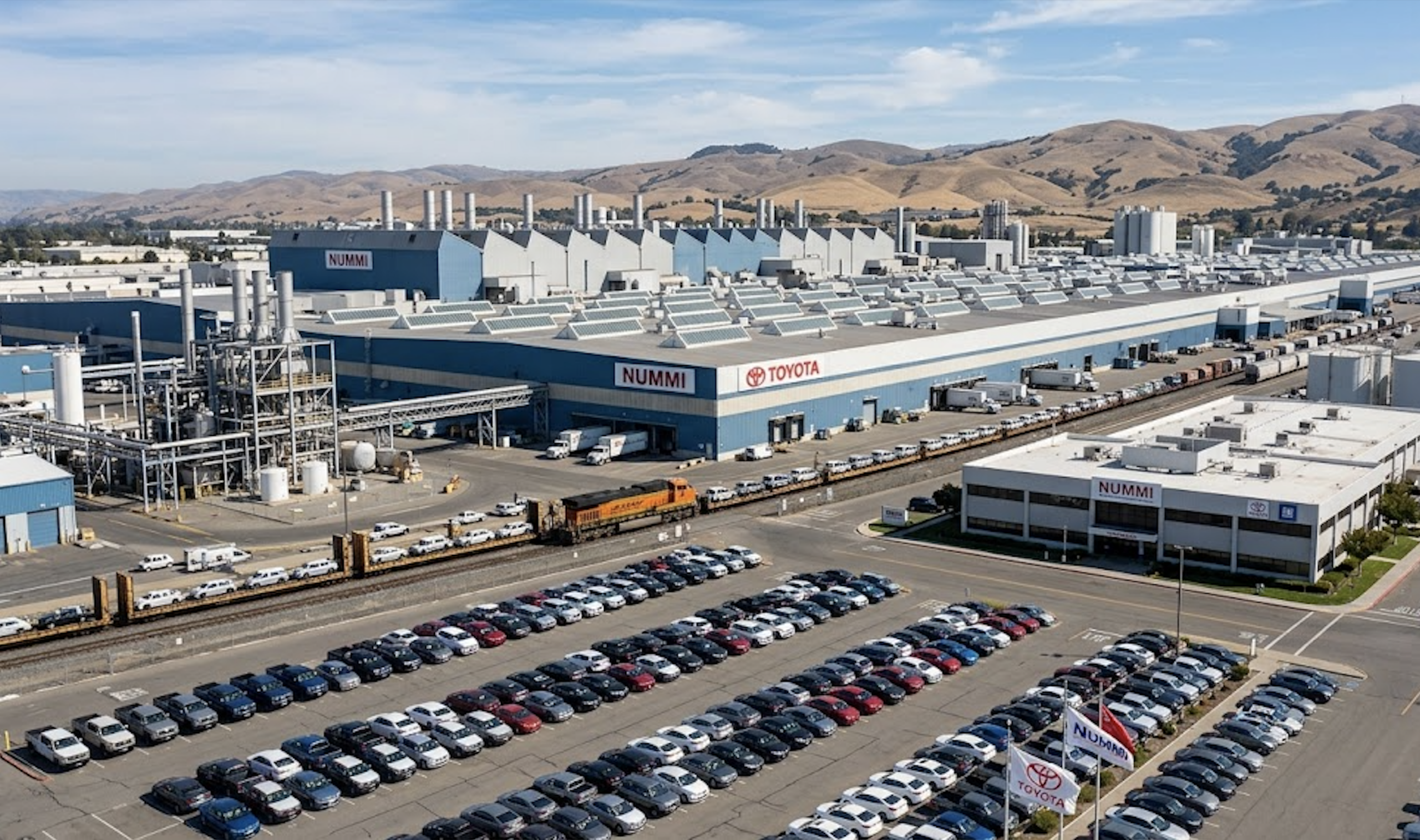
In the history of the automotive industry, there are few episodes that so vividly illuminate the clash between management philosophy and operational efficiency as the confrontation between General Motors and Toyota in the late 20th century. This was not merely a rivalry between two giants, but a collision of the old world—with its hierarchical and rigid structures—and the new world, characterized by flexible and human-centric approaches. In the 1980s, half of the U.S. automobile market belonged to General Motors. Suddenly, Toyota appeared on the market, gradually taking over General Motors’ market share. Interestingly, during that period, General Motors employed 800,000 people who produced 8 million cars, while Toyota employed 65,000 people but produced 4.5 million cars. It turned out that for every General Motors employee, there were 10 cars produced, whereas for Toyota, that number was 70. Just as a question arises for you now, the same question arose for General Motors’ management: how? As a result, General Motors was forced to close the Fremont plant and dismiss its employees.
The Management Gap and the “Kaizen” Philosophy
Behind this numerical abyss stood a revolutionary system that became known as the Toyota Production System (TPS) or “Lean Manufacturing.” While the American giant remained loyal to Henry Ford’s era conveyor model, where the worker was simply a tiny part of a mechanism, the Japanese introduced the “Kaizen” principle—continuous improvement. In the Japanese approach, each worker did not just tighten a bolt; they were considered a “problem solver.” It is also an interesting fact that in the early 80s, the sharp rise in gasoline prices in the U.S. (after the oil crises of 1973 and 1979) forced consumers to abandon giant, “gas-guzzling” American cars and switch to compact and economical Japanese models. General Motors, being an inert giant, was unable to reorient itself quickly. After that move, Toyota saw a great opportunity to start production in the U.S. market and proposed to General Motors to reopen the joint plant in the U.S., where the plant would belong to General Motors, but the management would be Toyota’s; the name was NUMMI.
NUMMI: The Experiment That Changed Business History
The NUMMI (New United Motor Manufacturing, Inc.) project became one of the boldest experiments in business history. For GM, this was an opportunity to learn how the Japanese produce small cars, and for Toyota, it was a testing ground to understand whether their culture could work on American soil and under the conditions of American labor unions. What does Toyota do as the very first step? That’s right—it brings back General Motors’ dismissed team with the same salaries and the same positions, but with one change. The only difference was that General Motors had 114 managers of various levels, while Toyota had 4. They achieved an average of one defect per car, whereas in the case of General Motors, that number reached an average of 12 defects. In the same plant, with the same people, in the same positions, but with completely different quality and management.
The “Andon” Cord and the Power of Trust
One of the secrets of this result was the “Andon Cord.” In General Motors’ old system, stopping the conveyor was considered a crime: if a worker saw a defect, they were obliged to remain silent so that production volume would not drop, as a result of which the defect reached the final consumer. At NUMMI, Toyota gave every worker the right to pull the cord and stop the entire plant in case of doubt. This was revolutionary. Workers who previously hated their management (the Fremont plant was famous for alcoholism and high rates of absenteeism) suddenly became the owners of their own work. And now the question: what was the difference between American and Japanese management? While General Motors tried to keep more business processes in its hands, Toyota did the opposite—it outsourced business processes. First, the supply of spare parts, then finance, logistics, IT, marketing, legal, and so on. The reason was technology, which was constantly changing and becoming more complex, and the automaker was unable to respond quickly to all changes, whereas in the case of outsourcing, they only had to demand and receive the result. Outsourcing enabled Toyota to move beyond being just a car manufacturer and focus also on providing services, which is an additional source of income for the business. And so, by simply changing the business model, Toyota managed to become the market leader.
Strategic Flexibility and the “Keiretsu” System
It should be added that Toyota’s outsourcing model was based not simply on finding cheap services, but on the “Keiretsu” system. This was the creation of long-term, almost family-like ties with suppliers, where the supplier was not an outsider but a part of Toyota. This allowed for the implementation of the “Just-in-Time” system, where parts arrive at the factory exactly at the moment they need to be installed on the car. This eliminated the need for huge warehouses, which for GM represented millions of dollars in frozen capital. The subsequent fate of NUMMI is also interesting. When the plant finally closed in 2010, it was bought by a young company—Tesla. Today, Elon Musk’s flagship factory is located exactly where Toyota once proved to the whole world that the management model is more important than the walls of the factory or the quantity of cars.
Thus, the story of NUMMI and Toyota teaches us that true efficiency is not the art of forcing employees, but the art of engaging them in the process and distributing focus correctly. You may notice how this story resonates in the modern business environment, where flexibility triumphs over scale.