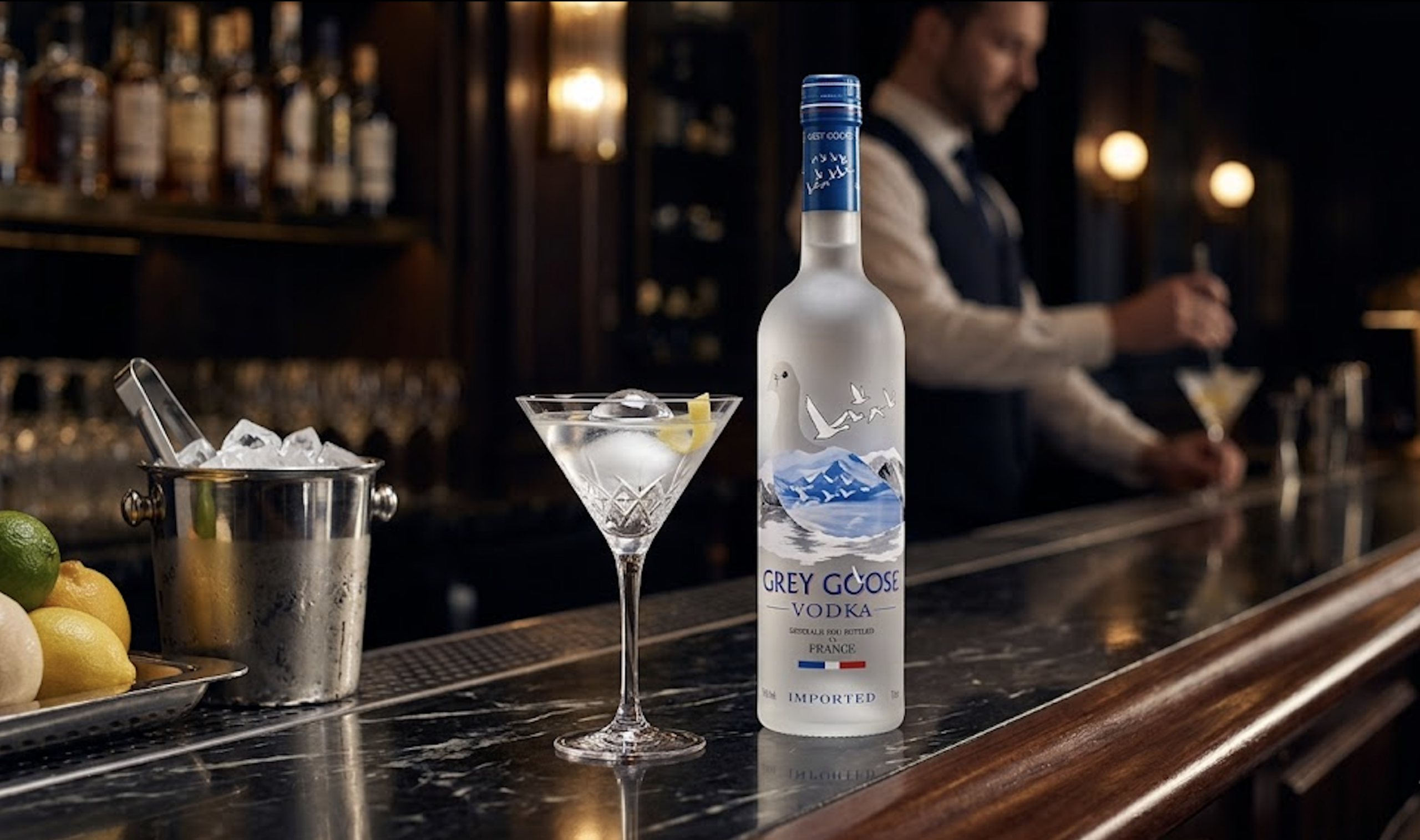
In the annals of modern entrepreneurship, few case studies offer as much raw insight into the power of perception as the rise of ultra-premium spirits. How to Create a 2 Billion Dollar Business in 7 Years is a question that many ask, but few answer with the clinical precision of the “Grey Goose” model. All of you are familiar with Grey Goose vodka, which you consider a French vodka. It sits atop backbars from London to Tokyo, a silent sentinel of status. Getting ahead of myself, let me say: this is a project that was invented in New York by a businessman named Sidney Frank. This distinction is crucial for understanding globalized marketing: the soul of the brand was American enterprise, while its “body” was French prestige. The vodka, which the French did not even consider their national drink, is suddenly packaged as a luxury class product and is sold more expensively than Absolut or Finlandia. This price gap was not a deterrent; it was the primary feature of the brand’s identity.
The Psychological Foundation of Capitalism and Storytelling
At first glance, it is an incomprehensible phenomenon, but capitalism is based on exactly such stories. In a saturated market, functional utility—the liquid’s ability to intoxicate—is a commodity. Value, however, is a construct of narrative. After all, people pay not only for the contents of the bottle, but also for the invented or real stories around it. This is the essence of “Brand Equity.” One of the key skills of modern businessmen is not only obtaining a good product, but also convincing people that this exact product is what they want to put on the table, to photograph for Instagram, and to show to friends. We see this reflected in the modern digital economy, where “shareability” is a form of currency. To understand how Frank achieved this, we must look at the man behind the curtain. And who is Sidney Frank? His biography is a testament to the “American Dream” filtered through a lens of high-stakes commerce. He was born in 1919 in Connecticut, grew up in a poor family, was admitted to Brown University, but due to financial problems could not continue his education. This early adversity likely fueled his later risk appetite. Later he married the daughter of the owner of a large alcoholic business. This strategic union provided the laboratory for his genius. It is exactly there that he gets acquainted with distribution and PR. In the world of fast-moving consumer goods (FMCG), distribution is the “blood” and PR is the “spirit.” Without both, a product remains an idea. In 1973, Frank founds the Sidney Frank Importing Company and imports Corazón tequila and Gekkeikan sake. These ventures were foundational experiments in niche marketing. That is to say, before Grey Goose, Frank was quite well versed in the global alcohol market, and it is exactly that experience of distribution and PR that he subsequently applies in his legendary project.
The Birth of a Concept: Why France?
In 1996 in the USA, an idea is born to him: to create a vodka which will be perceived not simply as the next strong drink, but as a symbol of eliteness. Frank identified a “white space” in the market: the “Ultra-Premium” segment. If there is French wine, champagne, cognac, then why should there not also be vodka? Now you will ask a question, but where is France, and where is vodka? Historically, vodka belongs to the “Vodka Belt” of Eastern Europe and Russia. Do not worry, if marketing exists, people will get used to that too. The audacity of Frank’s branding extended even to the name choice. A little later I will say how, but now let us continue. The name Grey Goose is not invented, it is the name of a German white wine which Frank used to import to the USA still in the years of his youth. This is a classic example of brand recycling and intellectual property leverage. The man simply takes the name of the wine and makes a vodka brand, in fact such a thing was possible ))
In 1997 he begins production in France, in the famous Cognac region. This move was a masterstroke of “Country of Origin” (COO) marketing. The choice was not random. France itself is a brand. It carries centuries of cultural weight. It is associated with refinement, luxury, and perfect taste. By placing production there, Frank bypassed the “harsh” image of Siberian or Polish vodka. Now imagine how that works in the subconscious of the consumer. It is natural that alone it is impossible to create such a brand and Frank invites one of the powerful specialists of cognac in the world, the Frenchman François Thibault. This added “Artisan Authority” to the marketing. And here already begins the real legend. Frank didn’t just want a story; he wanted a “reason to believe” (RTB). All the stages of production are thought out in details: from the milling and fermentation of the winter wheat of Picardy up to five-stage distillation. And the final stage was in Cognac, in the cradle of French elite drinks, where in the production they use the water that has passed through the limestone layers of the Champagne region. This specificity creates a moat of perceived quality. And the “degree” remains unchanged: 40%. Yes, the composition seems to be standard: grain and water, but the miracle is in the details. These details allow the brand to charge a “premium for provenance.” And here is the result. Thibault’s experience, added with Frank’s energy, gives its fruits. During a blind tasting held in Chicago, Grey Goose is recognized as the softest and tastiest among all the samples. This external validation was the catalyst for the brand’s explosion. Already in the first year the brand receives the platinum medal of the Beverage Testing Institute: 96 points out of 100. In the history of the vodka market this was the best start.
Pricing Strategy and the Veblen Effect
One must ask a critical economic question: Why does a 50 dollar vodka seem tastier than a 15 dollar one? From a chemical standpoint, the difference is negligible. Although, if we are honest, inside is the same thing: spirit, water, and a beautiful story on the label. However, the market does not function on chemistry alone. Grey Goose from the very start was almost three times more expensive than the competitors: 50 dollars against 15-17. And this was not chosen randomly, but an exact calculation. Frank was a practitioner of the Veblen Effect. Here the Veblen effect works. Named after economist Thorstein Veblen, this describes goods for which demand increases as the price rises, because they signal wealth. The higher the price, the stronger the desire to have the product. A luxury class product is bought not so much for the reason that it is objectively better, but because it is more expensive and exactly by that it separates you from the others and allows you to feel chosen. It is an act of “conspicuous consumption.” As a result, the number on the price tag itself becomes one of the main factors.
Visual Communication: The Packaging as a Silent Salesman
But, of course, only the price is little. The packaging is also important, on which the present French flag itself separates the vodka from the competitors. The frosted glass, the flying geese, the tricolor—every element screams “Continental Luxury.” There is no need to think of a story anymore: France itself is a country giving an association of traditions, drinks, luxury. Furthermore, Frank utilized “Category Borrowing” in his logistics. And as for the boxes, then Grey Goose uses wooden crates, as is the case with wines and it seems it was positioning itself not as a vodka, but as a vodka which plays in the world of wine. This subtle cue tells the consumer this is a “sipping” drink, not a “shooting” drink. It is interesting though, Frank could have done this same thing under a Russian name, however for the international audience, a luxury brand being French is more convincing than a Russian one, even if it is vodka. And as a result already in 2003 Grey Goose was selling 1.5 million crates annually. The growth was exponential because the brand became a social currency. Thus, Grey Goose becomes the iPhone of vodkas. It became the default choice for those who didn’t want to think about quality but wanted to be seen as having quality. The inside of the bottle is the same: vodka. But the double price gives the customer the realization: you have exactly that brand about which everyone knows and wants. But how did the drink become famous? The scheme is simple: Frank used any occasion where celebrities visited. He mastered the “Top-Down” influence model. They started to actively push Grey Goose forward in such places where ordinary people even with a VIP card would not always appear. This created a “trickle-down” desire. Elite bars, private parties, charity auctions, and even the “Oscar” award ceremony. The next level is already Hollywood and mass culture. In the “Sex and the City” series, the “Cosmopolitan” cocktail with Grey Goose becomes almost a hero of the second plan. This is the gold standard of product placement. And this was no coincidence. The show was watched by millions of women who dreamed about Manhattan and the beautiful life. Grey Goose is integrated into the culture more than just advertisement: through association. It is the “Halo Effect” in action. If Carrie Bradshaw drinks exactly that, then it is the right choice. This is how literate PR works. You are selling not alcohol, but a lifestyle, or a status. Imagine if there were Instagram at that time, what would happen.
The Billion-Dollar Exit: 7 Years to Success
The ultimate goal of many high-growth ventures is the acquisition. And when your brand already becomes a symbol of luxury, it remains only to wait when the large players will come. When you own the “mindshare” of the elite, you own the market. And in 2004 exactly that happens: Bacardi buys Grey Goose for more than 2 billion US dollars. This remains one of the most successful exits in history. In order for you to understand what kind of business is being talked about, let me note that the brand was only 7 years old. And during that time in the premium segment it had surpassed Absolut and Finlandia. ### The Legacy of Sidney Frank Sidney Frank: the man who had invented this whole scheme, literally in the course of one decade becomes a billionaire, about which he had always dreamed. It is a poignant reminder of the “Long Game” in business. Although that happens at 85 years of age: only 2 years before his death. He proved that it is never too late to revolutionize a category.
Thus, what is the secret of Grey Goose?
From the outside everything is simple: a French name, a high price, an elegant design, the right PR. But if it were easy, everyone would do it. But the real secret is that Grey Goose was able to turn an ordinary drink into a symbol of social status. In marketing, there is a concept called “Commodity vs. Specialty.” Classic vodka is a maximally used mass product. This is not about taste at all. In contrast to wine or whiskey, it does not have dozens of shades of aroma. It is the ultimate blank canvas. Here the formula is simple: spirit added with water. If even such a “naked” product is possible to package with a veil of luxury and eliteness, to give some French story, it means marketing is capable of turning literally everything into a symbol. This is the most powerful lesson for any entrepreneur or marketer. Grey Goose showed: people pay for emotion and for the possibility of associating themselves with a certain lifestyle, and not for the transparent liquid inside the bottle. The meaning is not in the taste, but in the social code, which the surrounding people read. Capitalism works like this: not the product itself is sold, but the perception of it, the feeling created around it. Grey Goose obviously demonstrates that even the simplest product can be turned into a symbol of wealth and social success, if you build the price, the image, and the communication correctly. And while some see a genius business in this, others must remember: marketing always plays on our emotions.